A Small Glossary of Tarot
Every term you will actually meet at the table, defined honestly and in plain English, with the loaded words given the fair hearing they rarely get.
What This Is (and Isn’t)
Every craft grows a private language, and tarot’s is older and stranger than most. That language does two jobs at once. It lets practised readers speak precisely. And it makes newcomers feel like they’ve walked into the wrong room. This page exists to end the second job.
It’s small on purpose. These aren’t all the words tarot has ever used. They’re the ones you’ll actually meet reading this site, opening a deck, or wandering into a conversation about the cards. Each one gets plain English, and the loaded ones get honesty instead of mystique.
One practical note: every term below has its own anchor link (the small # beside each word). If you ever want to point someone at exactly one definition, click the # and share the address it gives you.
Part One: The People at the Table
Tarot’s cast list is short, and the first surprise is that in the most common reading of all, one person plays every part.
Querent#
The person the reading is about: the one who asks. It comes from the Latin quaerere, to seek. When you read for yourself, you are querent and reader at once. That is the normal case, and always has been.
Reader#
The person interpreting the cards. A good reader’s main tool is questions, never predictions. The card supplies an image; the reader helps the querent find where it lands in their life.
Self-reading#
Reading your own cards. Sometimes warned against, mostly by people selling readings. In truth it’s tarot’s main mode, with its own pitfalls and its own ways of handling them.
Significator#
A card chosen on purpose, not drawn, to stand for the querent in a spread. Classically it sits at the centre of the Celtic Cross. Entirely optional, and most modern readers skip it.
Part Two: The Deck Itself
Seventy-eight cards, two families, four suits, and a handful of words that sound grander than what they describe.
Arcana (and arcanum)#
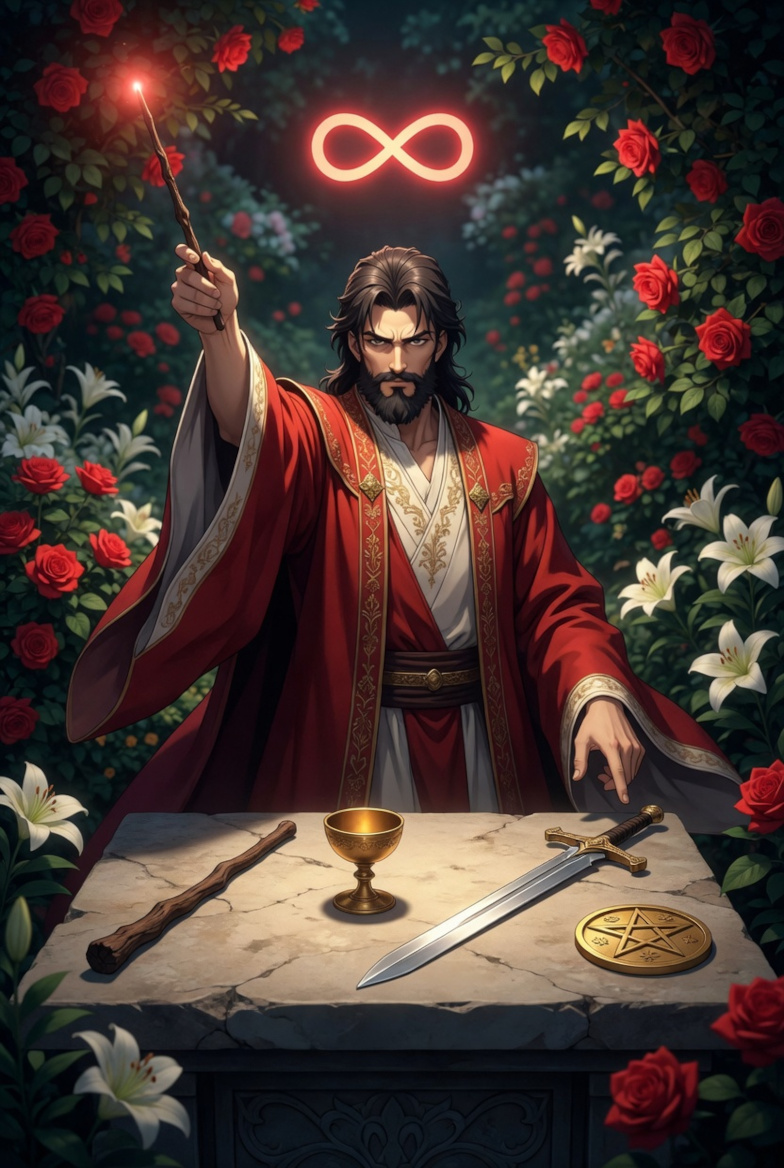
Latin for “secrets”. Arcana is the plural; a single card is, technically, an arcanum. It is the grandest word in tarot, and it describes what is mostly a set of pictures about being a person.
Major Arcana#
The 22 named and numbered cards, from the Fool (0) to the World (21): the deck’s big themes, read as one story called the Fool’s Journey. When people picture “a tarot card”, they’re almost always picturing a Major.
Minor Arcana#
The other 56 cards, organised into four suits of fourteen. Minor means smaller in scale, not in importance: these are the cards of daily life, and most readings are mostly Minors.
Trumps#
The older name for the Major Arcana. It comes from trionfi, the “triumphs” of the Italian card game tarot began as in the 1400s. A useful reminder that the deck was a game for three centuries before it was anything else.
Suit#
One of the Minor Arcana’s four families: Wands (fire, will and work), Cups (water, feeling), Swords (air, thought), Pentacles (earth, the material). Each runs Ace to Ten plus four court cards.
Pips#
The numbered cards, Ace to Ten. In older decks like the Marseille these carry no scenes at all, just the suit symbol counted out, exactly like playing cards. Pips with pictures on are a 1909 invention that stuck.
Court cards#
The sixteen “people” cards, four per suit. Most decks run Page, Knight, Queen, King; ours uses the Golden Dawn’s Princess, Prince, Queen and Knight. Read them as personalities and postures, not necessarily as specific people.
Ace#
The first card of each suit: the suit’s element in its purest, most concentrated form. An Ace is a seed rather than an event; everything the suit can become, offered and not yet begun.
Part Three: At the Table
The working vocabulary of an actual reading: what happens between picking the deck up and putting it down.
Reading#
The whole act: a question, one or more cards, and the interpretation that connects them to the querent’s life. On this site we treat a reading as a mirror rather than a forecast. It shows you your own material from an angle you didn’t choose.
Spread#
A fixed layout of positions, each with its own question, decided before you shuffle. Past, present, future is a spread; so is the ten-card Celtic Cross. A single card pulled with one clear question is already a complete spread.
Position#
One slot in a spread, and really one pre-agreed question. The same card means differently in different positions because the question changed, which is the whole mechanism of a spread.
Draw (or pull)#
Taking a card from the shuffled deck. “A daily draw” is the one-card practice most readers build everything else on.
Shuffle and cut#
The randomising. The shuffle mixes; the cut, traditionally done by the querent, gives the deck its final order. Physical decks shuffle imperfectly and remember their past order. That is worth knowing before you read meaning into repeats.
Jumper#
A card that leaps or falls out mid-shuffle. Tradition reads it as a card with something urgent to say; the drier truth is that cards fall out of shuffles. If it happens and the card lands face up, there’s no harm in hearing it out.
Clarifier#
An extra card drawn to shed light on a confusing one. Use one at most: a second clarifier is usually the reading being re-rolled until it says something nicer, which is a different activity.
Upright#
A card that arrives the right way up: its standard, front-door meaning.
Reversal (reversed)#
A card that arrives upside down. At least six systems exist for reading them, from “the meaning blocked” to “the dial turned down”. The honest rules: pick your system before you shuffle, and know that skipping reversals entirely is completely fine.
Daily draw#
One card, most days, with a small question: the practice that actually teaches tarot. Cheaper than a course, quieter than a guru, and the habit every big spread secretly depends on.
Tarot journal#
The written record of your draws and what you made of them. Writing is where the practice compounds: a card noticed is worth something, but a card written down starts keeping receipts on your patterns.
See the whole vocabulary used in order, from first shuffle to first full reading:
How to read tarot: the honest beginner’s guidearrow_forwardArcana is just Latin for secrets, and the biggest secret is how ordinary the words turn out to be.
Part Four: The Machinery Underneath
Names for the traditions and systems the modern deck runs on. None of this is required knowledge; all of it explains why the cards say what they say.
Rider-Waite-Smith (RWS)#
The 1909 deck, drawn by Pamela Colman Smith to Arthur Waite’s design. It gave the pips their scenes and became the template for most decks since. When a meaning book describes “the” image on a card, it usually means this deck’s.
Marseille#
The older French pattern, standardised in the 1600s: plain pips, woodcut Majors, and the deck’s longest unbroken tradition. Reading it leans on number and suit rather than scene.
Golden Dawn#
The Hermetic Order of the Golden Dawn, founded in London in 1888. This occult society built the correspondence system, cards mapped to signs, planets and elements, that sits under most modern decks, including ours. Victorian, influential, and the reason your zodiac sign has a tarot card.
Thoth#
The deck designed by Aleister Crowley and painted by Lady Frieda Harris in the 1940s. It is the Golden Dawn lineage’s other great deck: denser and more abstract than the RWS, with renamed courts and retitled Majors.
Correspondence#
A chosen, meaningful pairing between a card and something else: a zodiac sign, a planet, an element. Chosen is the honest word. Nobody discovered that Strength “is” Leo. The pairings survived because a century of readers found they fit.
Element#
The four classical temperaments the suits map to: fire (Wands), water (Cups), air (Swords), earth (Pentacles). Less a physics claim than a filing system for kinds of human weather.
Elemental dignities#
The Golden Dawn technique for judging whether neighbouring cards strengthen or weaken each other, by element. A well-dignified card speaks louder, an ill-dignified one more quietly, and nothing leaves the table. We keep a complete guide.
Decan#
A ten-day slice of the zodiac year. There are thirty-six in all, three per sign, and the Golden Dawn system gives each one its own Minor Arcana card. Our tarot calendar runs on them, one presiding card per decan.
Birth card#
The Major Arcana card (or pair) you reach by adding the digits of your birth date and reducing the total. It is arithmetic rather than astrology, and a different thing from your zodiac card. That is why the two sometimes argue.
Zodiac card#
Your sun sign’s Major Arcana card by Golden Dawn correspondence: Aries the Emperor, Leo Strength, Scorpio Death, and so on through all twelve. Best read as a portrait of the sign’s lesson, not a compliment or a forecast.
Numerology#
Reading meaning in the cards’ numbers: aces as beginnings, nines as completion, and the digit-adding that links high cards to low ones. Eighteen reduces to nine, which is why the Moon and the Hermit are said to share a root.
Part Five: Words People Worry About
The loaded vocabulary: the words that make people hesitate at the door. Each one defined by what it actually means, not by its reputation.
Divination#
Seeking insight through signs and symbols. The word promises the future. The practice, for most modern readers, is structured reflection: using an image you didn’t choose to see your own situation from a new angle.
Fortune-telling#
Prediction as a service: the crystal-ball image tarot inherited and can’t quite shake. Worth separating from the practice itself, because survey after survey finds most people use tarot for reflection, not prophecy.
Occult#
Literally “hidden”, nothing more. Astronomers still use it exactly this way: an occultation is one body hiding another. The word’s spooky reputation is guilt by association, not etymology.
Esoteric#
Meant for the inner circle: specialist knowledge, as opposed to exoteric, public knowledge. Inside knowledge rather than dark knowledge; every trade with jargon, tarot included, is esoteric to someone.
Cleansing#
Resetting a deck: by moonlight, salt, smoke, knocking, or ritual, depending who you ask. Whatever else you believe, it works reliably as punctuation. It marks, on purpose, that one chapter of use has ended and another is beginning.
Intuition#
Your pattern-spotting running ahead of your reasoning. Genuinely useful at the table, and genuinely fallible. It is loudest exactly when you’re anxious, which is when it’s least reliable. The Moon card exists to make this point.
Energy#
The hardest-working word in tarot, covering everything from mood to fate. When this site uses it, we mean something specific and unmysterious: your attention, and the state you bring into the room.
Psychic#
Claimed perception beyond the ordinary senses. You’ll meet readers who claim it and readers who don’t. Our position is simply that the cards work without it, because what a reading runs on is already in the room: you.
The longer, kinder answer for anyone worried the whole subject is dangerous:
Is tarot evil? An honest answerarrow_forwardAnd for readers who want the whole practice with none of the metaphysics, these translations grow into a complete manual:
Secular tarot: reading without beliefarrow_forwardA Few Words of Ours
Three terms you’ll meet on 78Paths specifically. Fia is our AI reader: draw a card and she’ll read it with you, in her own voice. Deck personalisation means the site shows every card in the deck you’ve chosen, so the pictures in any article match the deck in your hands. And the journal is where your draws and one-line entries live, private to you, prompt links and all.
The fastest way to learn the vocabulary is to need it:
Pull a free readingarrow_forwardJargon is a door policy; a definition is the door propped open. None of these words was ever the hard part of tarot. The hard part is the same as it always was: sitting with an honest image long enough to tell yourself the truth about it. Everything above is just vocabulary for describing what happened when you did.