The Fool’s Journey: The Major Arcana as One Story
All twenty-two Major Arcana read as a single road: three acts, twenty-one stations, and one traveller who is always you. A reference for locating yourself on it.
One Story, Twenty-Two Cards (And Where the Idea Comes From)
Lay the twenty-two Major Arcana out in order and something remarkable happens: they read. Not as twenty-two separate omens, but as one continuous story, a traveller setting out with nothing, meeting teachers and temptations, losing everything that was built wrong, and arriving somewhere that turns out to be another beginning. Readers call it the Fool's Journey, and it's the single most useful frame ever put on the Majors, because it turns a memorisation problem into a story you already know. You've lived stretches of it. You're standing on it now.
Honesty first, as ever: the journey is a lens, not an ancient secret. The trumps began as a Renaissance picture parade, and the "journey" reading was popularised in the twentieth century, most influentially by the American teacher Eden Gray in 1970. That provenance doesn't weaken it; it explains why it fits so well. The frame survived because generations of readers found that the sequence genuinely maps how big changes feel from inside: the naive start, the gathering of tools, the collapse of the false version, the quieter arrival.
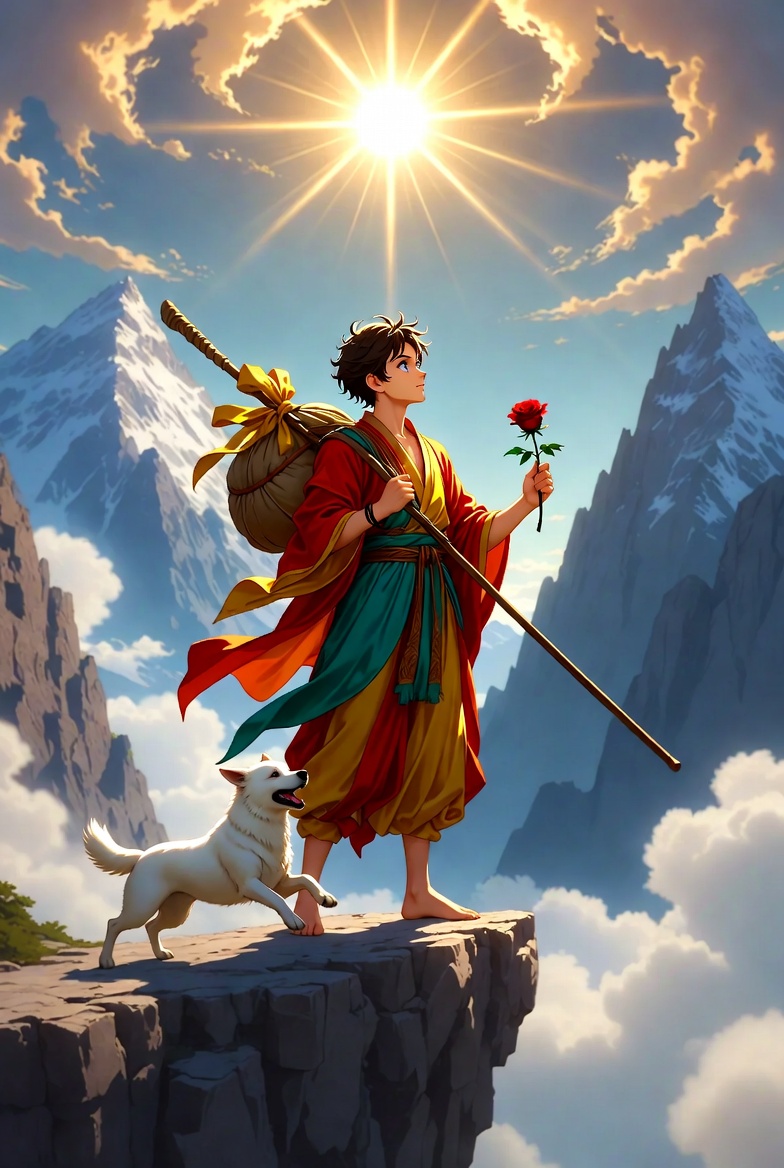
The traveller is the Fool, numbered zero: the open start before the counting begins, the leap before the look. Zero because he isn't a stage of the journey; he's the one walking it, present at every station, and every card that follows is something the road does to him. Which means every card that follows is something the road does to you. Here's the whole map, in the three acts readers have long divided it into.
Act One: Learning the World (I to VII)
The first seven stations are the outer curriculum: the powers, teachers and structures every life meets first. The Fool arrives knowing nothing and act one hands him the toolkit, will, intuition, nurture, order, tradition, love, drive, each one a genuine gift and each one incomplete, which is why the road keeps going.
The Magician: as above, so below
The first lesson: you have tools, and intention makes them real. Everything on the table is already yours; the skill is directing it. The journey begins with agency.
The High Priestess: what you know without knowing why
The Magician’s counterweight, met immediately: not everything is done by doing. There is a knowing that arrives unbidden, and learning to consult it is the second lesson, not the last.
The Empress: life growing in every direction
Abundance, nurture, the body, the world as garden. The traveller learns that things grow when tended and that not everything needs managing; some things need feeding.
The Emperor: order built from intention
The garden gets a wall. Structure, boundaries, the rules that make things last. The gift is stability; the lesson inside the gift is that order serves life, not the reverse.
The Hierophant: the sacred made into ritual
Tradition: the accumulated answers of everyone who walked before. The traveller learns what the culture knows, which is a genuine inheritance, and quietly notices it doesn’t answer everything.
The Lovers: the choice that defines you
The first station that cannot be taught, only made. Love, yes, but underneath it: alignment, the choice that costs the other options. Act one’s tools all point here, and none of them can make the choice for you.
The Chariot: victory through mastery of self
Act one ends in triumph: will, direction, opposing forces held by intention alone. The traveller has mastered the outer world, and the card’s quiet warning is that the next act happens where chariots cannot go.
Act Two: Learning Yourself (VIII to XIV)
The road turns inward. Act two is the middle of any real change, less glamorous than the start, harder than the finish, where the work stops being about the world and starts being about the person doing it. Strength opens it by retiring the Chariot's method: what worked out there, force and direction, is exactly what fails in here.
Strength: gentleness is the greatest power
The lion isn’t beaten; it’s met, bare-handed and calm. First inner lesson: your own appetites and fears respond to patience, not force. The Chariot’s whip is no use on yourself.
The Hermit: the light you carry is for yourself first
The deliberate withdrawal. The traveller climbs away from the crowd’s torches to find which light is actually theirs. Solitude here is a tool, not a wound.
The Wheel of Fortune: the only constant is the turning
Mid-journey, the road teaches its hardest neutral fact: cycles turn without consent. Rise and fall stop being verdicts and become weather, and the traveller learns to ride rather than grip.
Justice: truth is the only scale that holds
The audit. Everything done so far gets weighed honestly, and the sword beside the scales means the weighing ends in consequences. The journey cannot continue on flattering accounts.
The Hanged Man: surrender is not defeat
The pause nobody chooses and everybody needs: suspended, inverted, and, to everyone’s surprise, at peace. Some knowledge only arrives when the striving stops. The view from here changes everything after.
Death: the end is the beginning in disguise
The act’s summit. Something the traveller has been carrying, a role, a version of themselves, a finished chapter, is allowed to actually end. Nothing on the road is harder or more freeing, and nothing after it is possible without it.
Temperance: alchemy in the everyday
After the ending, the blending: the angel pouring at the one sustainable rate, one foot in water, one on land. The traveller learns measure, the art act three will test to destruction.
Act Three: The Great Trials and the Arrival (XV to XXI)
The final act is the deep water: the deck's most feared cards followed immediately by its most beautiful, in an order that is itself the teaching. Chains, then lightning, then the open sky, and then the slow return of light. Nobody walks act three by accident, and nobody who has walked it reads these cards as omens again.
The Devil: the chains you forget you chose
The trial of comfort. Everything gained so far can calcify into arrangements that pay just enough to keep, and the chains are loose, which is the entire test: seeing them is the freedom.
The Tower: what is built on false foundations must fall
What isn’t set down by choice comes down by lightning. The Tower only ever takes what was built wrong, which is why survivors of it report the strangest feeling on the road: relief.
The Star: hope is not naive, it is necessary
The first card after the collapse, and the deck’s gentlest: open sky, bare feet, water poured freely. Hope here isn’t optimism; it’s what remains when everything false is gone, and it turns out to be enough.
The Moon: not all that is hidden is gone
The last dark stretch: the path between the towers by half-light, where old fears surface for a final hearing. The traveller walks it anyway, which is the whole instruction.
The Sun: joy that needs no permission
Daylight. Clarity, vitality, the simple goodness that needed no earning after all. After the Moon’s ambiguity, the Sun’s gift is that there is nothing to decode.
Judgement: the call you have always been waiting for
The reckoning that isn’t a punishment: the whole journey rises up and asks to be answered. The traveller sees everything they have been and is summoned to what they are becoming.
The World: the journey complete, the journey beginning
Arrival. Wholeness, the dance inside the wreath, all four elements present and speaking. And the tagline gives the game away: the World is also a door, and on the far side of it a familiar figure is packing a small bundle, numbered zero.
Using the Journey: Where Are You Standing?
The map earns its keep the day you use it to locate yourself, and there are three honest ways in.
Ask which act you're in. Learning the world (building, acquiring tools, meeting teachers)? Learning yourself (the inward turn, the audit, the ending that's due)? Or the deep water (the trial, the collapse, the recovery of light)? Most people know immediately, and the act names what kind of help the moment needs.
Then ask which station. Read your act's seven cards above and notice which one you'd rather not look at; that one, reliably, is yours. A Major landing in any ordinary reading can be read the same way: not as an omen, but as a road sign saying you are here.
And know your recurring station. Your birth cards, from our calculator, are the stations you return to all your life, the chapter of the story you keep being asked to reread at deeper levels. The journey isn't walked once; you cross it in every project, every relationship, every year, and some stations have your name carved on them.
One thing the map is not: a ranking. The Chariot is not a lesser person than the Star, and standing at the Devil is not failure; every station is the right place for the traveller who is standing there. The Fool is at all of them, still carrying the same small bundle, still, on the whole, glad he leapt.
One honest line for each: the act I am in, the station I am standing at, and what it asks of me. If you cannot choose between two stations, you are usually on the road between them, which is also an answer.
The station you avoid
Read your act’s seven cards and notice the one you skimmed. Give it two minutes and one written sentence. The station you avoid is nearly always the one you are approaching.
The Fool is numbered zero because he is not a stage of the journey. He is the one walking it, and so are you, and the road knows the way.
Where the Majors actually come from, parade to journey, honestly told:
The real history of tarotarrow_forwardFind the stations you return to all your life: your birth cards, from your birthday, with the calculator:
What tarot card am I?arrow_forwardOr meet the road where it finds you today: one free card, no sign-up.
Pull a free readingarrow_forwardTwenty-two cards, three acts, one traveller. Learn the world, learn yourself, survive the deep water, arrive at a door. The Majors were never twenty-two things to memorise; they were one story told at walking pace, and the reason they keep landing on your life is that your life is where the story was collected from.