
You pulled the Prince of Pentacles and felt a little flat. The picture is calm. The pace is slow. In a deck full of fire and drama, he looks almost ordinary. That is the point. He is one of the most quietly useful cards you can draw: the one that finishes things. In most decks this same card is called the Knight of Pentacles. Our deck calls him the Prince. Same card, same meaning.
What a Court Card Is
The sixteen court cards are the deck’s people. A court card can show a person in your life, a mood or drive inside you, or plain advice. Princes are the ones in motion: they go out and do the work of their suit.
His elemental title is Air of Earth. Air stands for thought and planning. Earth stands for practical, real-world things. He is a mind put to everyday work: method, routine, a plan followed step by step.
In the Pentacles court the story runs like this. The Princess studies. The Prince builds. The Queen looks after what has been built. The Knight has mastered it. (In most decks our Knight of Pentacles sits in the King’s chair and is called the King of Pentacles.) For the full set of sixteen, see the court cards post and the court card reference.
What’s Actually in the Picture
In the classic Rider-Waite image a knight sits on a heavy horse that is standing completely still in a ploughed field, holding a coin and looking at it. Of all the knights in that deck he is the only one whose horse isn’t moving.
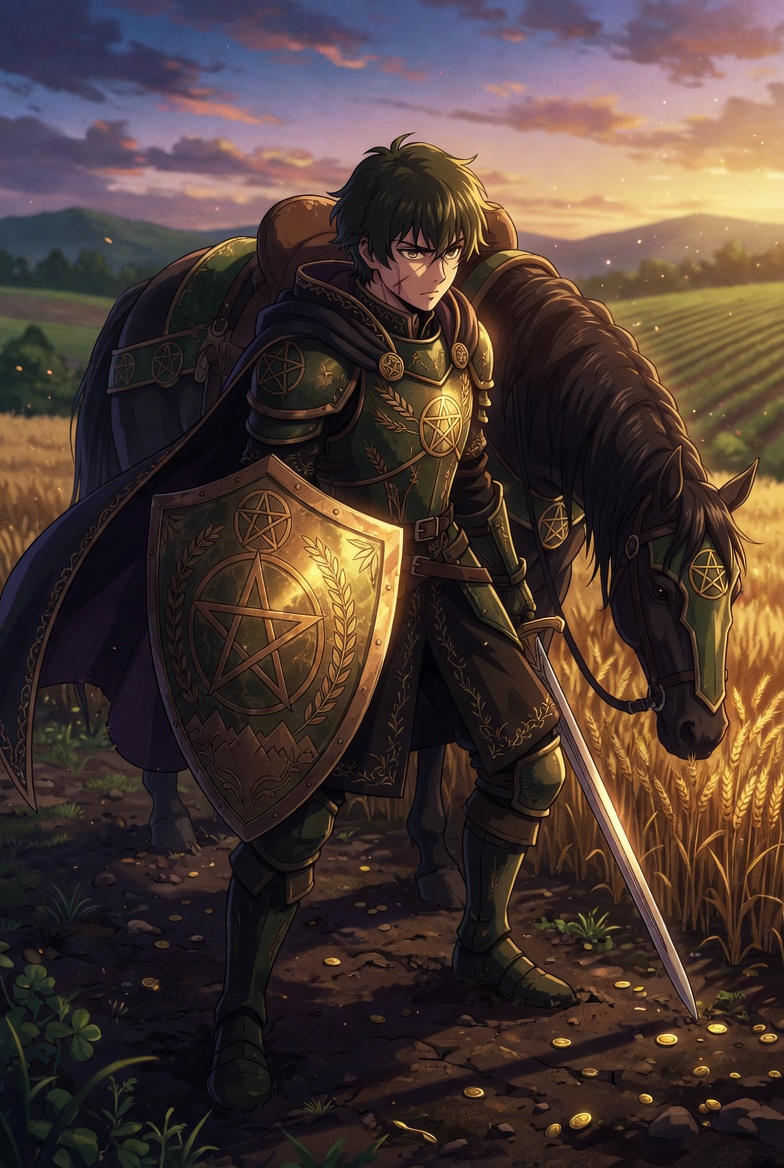
Our Prince of Pentacles is different. A young man with dark hair and a small braid rides a black horse at a steady pace across a hillside at dusk. His face is calm and serious. He wears dark green armour patterned with gold leaves and a long green cape that streams behind him. A large gold shield stamped with a pentacle hangs at his side. The horse wears a green faceplate and a strap of gold pentacles across its chest, and green vines are growing along its harness. Behind him the hillside is cut into terraced fields, step by step, and long golden grass grows at the horse’s feet.
The terraced fields are slow work, built by hand one level at a time. The vines growing on the harness show things growing while he keeps moving. His calm face shows no rush and no fuss. He is still slow and steady, but he is moving.
What He Means in a Reading
As a person he is the reliable one who finishes what others start. Patient, practical, a bit quiet, good with routine. He could be someone in your life, or you in a season of building.
As a mood or drive he is steady progress: the long middle of a real project, a plan you are following step by step.
As advice he says keep going at your own pace. Do the next small piece today. Every dull step counts.
Two Princes: the Fastest and the Slowest

Our Prince of Wands is a grinning red-haired rider on a black horse with a mane of flames, holding up a burning staff topped with a fiery bird, racing across a desert. His tagline is “Fast, brilliant, and slightly dangerous.”
Both princes are moving. One races. One keeps a pace he can hold for years. You need both kinds of energy at different times. This card points to which one the moment needs.
The Honest Edge
Steady can tip into stuck. You keep doing the same thing out of habit long after it stopped working. The Seven of Pentacles deep-dive covers the pause to check whether to keep going. Its tagline is “The harvest is not yet. But it is coming.”

The reliable one can also end up carrying everyone else’s load. The Ten of Wands says “You have carried this long enough.” Slow is fine. Slow and unhappy is worth a look.
In Love
As feelings the Knight of Pentacles (this card in most decks) is steady, serious, and sure. He is slow to say it and quick to show it by turning up, fixing things, and keeping promises.
For singles it can be a slow-building connection, or a season of building your own life first. In a relationship it is commitment shown through everyday care. A card about your side can speak. A card drawn to read their heart is your hope wearing their face. Watch what they actually do. The does-he-like-me post covers that ground.
Slow and steady is lovely. Slow and silent can leave the other person guessing, so say things out loud too.
In Career and Money
He appears with long projects, a steady job, a qualification done one module at a time, and savings that grow slowly. The useful move is to decide on a pace you can keep on a bad day. The career post goes into more detail.
The card can’t judge any investment. For real money decisions, talk to a qualified, regulated financial adviser.
The Prince of Pentacles Reversed
Reversals here follow a system you choose before you shuffle, set out in the reversals guide. Read that way, the Prince of Pentacles reversed can mean several things.
Blocked: stuck in a rut, routine with no progress, or procrastination dressed up as patience.
Internalised: steady work nobody sees yet.
The dimmer: a slower pace than usual, and that’s allowed.
Leaving: a long project ending, or a routine you’re ready to drop.
None of the systems reads it as “you’ll never finish”.
Best Combinations
Two cards together work like two words in a sentence: each changes what the other means. See the combinations post for the full idea.
Prince of Pentacles + Princess of Pentacles. The student becomes the worker, the next step in the same story. Her deep-dive covers the first chapter.
Prince of Pentacles + Knight of Pentacles (the King in most decks). Where the steady work leads: mastery built over years. His tagline is “He built it once. He can build it again.”
Prince of Pentacles + Prince of Wands. Speed meets steadiness, often a clash of pace between two people or two plans.
Prince of Pentacles + Seven of Pentacles. Steady work meets the pause to check. Keep going, or look up first.
A Practice: The Bad-Day Minimum
Pick one long thing you want to finish. Decide the smallest amount you would still do on your worst day: five minutes, one page, one email, one walk. Do that amount every day for a week, and more when you feel like it. Tick each day off. The point is a pace you can keep, so the work never fully stops.
The journal line: The long job: ___. My bad-day minimum: ___. Days I kept it this week: ___. Write it in your journal ›
What This Card Won’t Do
It can’t promise the work will pay off, give a timeline, or tell you what another person feels. See the timing post and the questions-tarot-can’t-answer post.
The Bottom Line
The Prince of Pentacles is the card that finishes things. He turns up every day and does the next bit of work, and that is how big things actually get built. In a culture that celebrates quick wins, he stands for steady effort that adds up.
He rides at a steady pace across terraced fields built one level at a time, vines growing on the harness as he keeps moving.
FAQ
Is the Prince of Pentacles the same as the Knight of Pentacles? Yes in most decks. Our deck also has a Knight of Pentacles, who matches the King of Pentacles in most decks.
What does the Prince of Pentacles mean? He means steady work that gets finished: routine, method, and showing up for the long middle of a project.
What does the Knight of Pentacles mean as feelings? Steady, serious intentions shown through actions: turning up, fixing things, keeping promises. Slow to speak, quick to demonstrate.
What does the Prince of Pentacles mean in love? A slow-building connection or everyday care that proves commitment. Say the words too, so the other person doesn’t have to guess.
What does the Prince of Pentacles reversed mean? Stuck in a rut, work no one sees yet, a slower pace that’s allowed, or a routine you’re ready to drop. None of these means you’ll never finish.
Is the Knight of Pentacles a yes or no? A slow yes: yes if you’re willing to put in steady work. See the yes-or-no post for the house caveat.
What does the Prince of Pentacles mean for career? Long projects, steady jobs, qualifications done one module at a time. Set a pace you can keep on a bad day.
What’s the one long job you could do a little of today? Pull a free online tarot reading →
forum Comments
Loading comments…