
“Shadow work” is everywhere now, and most of it tells you almost nothing. Face your shadow. Integrate the parts you’ve rejected. Sit with the discomfort. All true, all useless, because none of it tells you where to start or what to actually do when you sit down.
Here’s the quiet secret: tarot solves that problem better than almost anything else, and it’s been doing it for centuries without calling it shadow work. The reason is simple. The hardest part of looking at your own hidden material is finding the door. Your mind is very good at steering you away from the exact things you most need to look at. A card doesn’t let you do that. You pull an image, the image asks a question you didn’t choose, and suddenly you’re standing in front of the thing you’d have talked yourself out of.
This post gives you a system: which cards open which doors, a journal template you can reuse every time, and a set of safety notes for knowing when to close the deck and call a professional instead. It works whether you own a deck or use a free online tarot reading on your phone.
What “Shadow Work” Actually Means (Minus the Mystique)
The shadow is a term from the psychologist Carl Jung, and stripped of the incense it’s very ordinary. It’s the collection of things about yourself you’ve pushed out of view because, at some point, they felt unacceptable: the anger you were told was “too much,” the neediness you learned to hide, the envy you’re ashamed of, the grief you never finished. None of it disappeared. It just went underground and started running things from there.
Shadow work is the practice of bringing those parts back into the light long enough to look at them honestly, without either drowning in them or pretending they’re not yours. That’s it. You’re not exorcising anything. You’re getting reacquainted.
The problem is that the shadow, by definition, hides from you. You can’t just decide to think about your blind spot, because it’s a blind spot. This is exactly where tarot earns its keep. The card comes from outside your usual train of thought, so it can point at something your mind was busy avoiding. That’s why tarot is shadow work on easy mode: it hands you the door your defences were keeping shut.
Why Cards Work as Portals
A tarot reading doesn’t tell you anything you don’t already know. It reorganises what you know and shows it to you from an angle you’d never have chosen on your own. That reframe is the whole mechanism. Psychologists call it projection: you meet an ambiguous image, and what you read into it comes from you.
So when you pull the Devil and your gut reaction is “that’s about my drinking” or “that’s my job” or “that’s how I am in that relationship,” the card didn’t know any of that. You did. The image just gave your own buried knowledge somewhere safe to land. That’s the same move a good therapist makes with a well-timed question, and it’s the same move journaling makes when you write past the point you meant to stop. Tarot does it with pictures, fast.
Certain cards are especially good doors. Here are three of the most reliable, and how to walk through each one.
The Devil: What Owns You
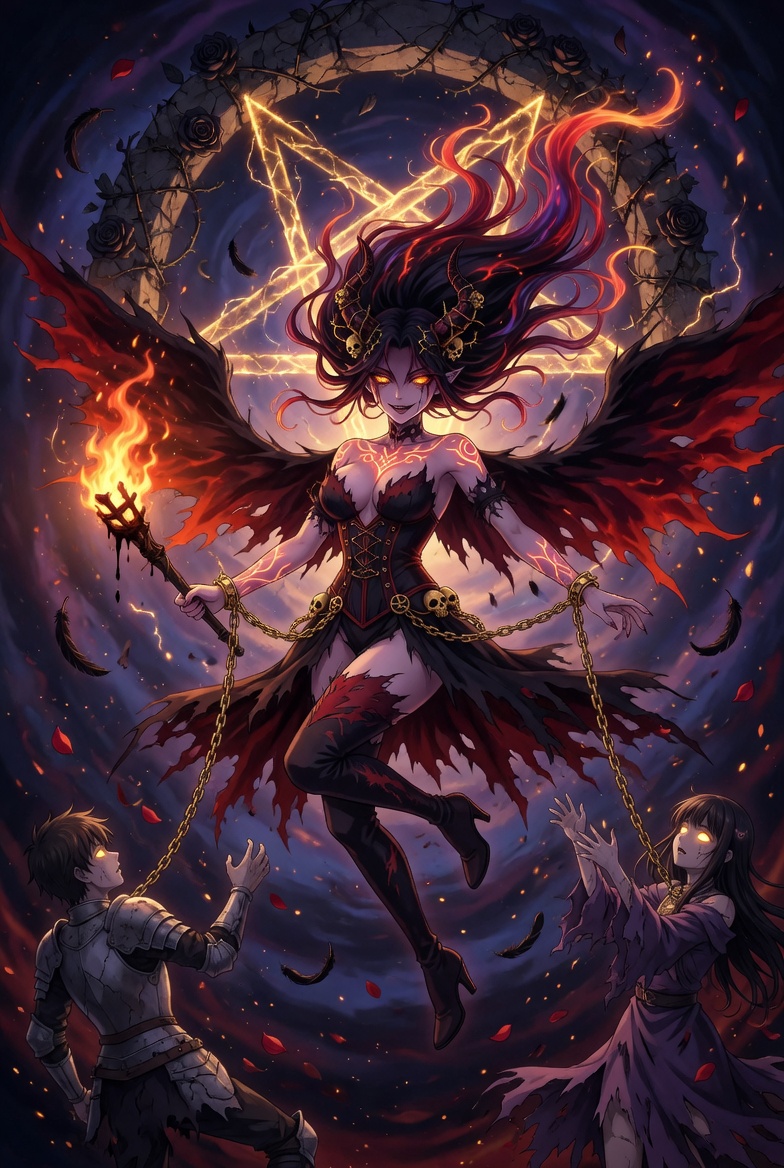
The Devil is the headline shadow card, and it’s badly misread as a card about evil or temptation. Look at the classic image again: two figures stand chained to the block a horned figure sits on, but the chains around their necks are loose. They could lift them off and walk. They don’t.
That’s the whole teaching. The Devil is about the bondage you don’t admit is optional. The habit you call a personality trait. The resentment you feed because letting it go would mean grieving. The relationship dynamic you complain about but keep re-choosing because the alternative is scarier. When this card comes up in shadow work, it isn’t asking “what’s wrong with you.” It’s asking a sharper question: what are you getting out of the thing you say you want to stop? There’s always a payoff. Numbing works. Anger feels like power. Staying small keeps you safe. The chain stays on because some part of you is still holding it.
Work it like this: name the chain out loud, then name the payoff. “I keep doom-scrolling at night, and what I get from it is not having to feel how lonely the day was.” That second half is the shadow. That’s the part you don’t usually say.
The Moon: What You’re Not Letting Yourself See
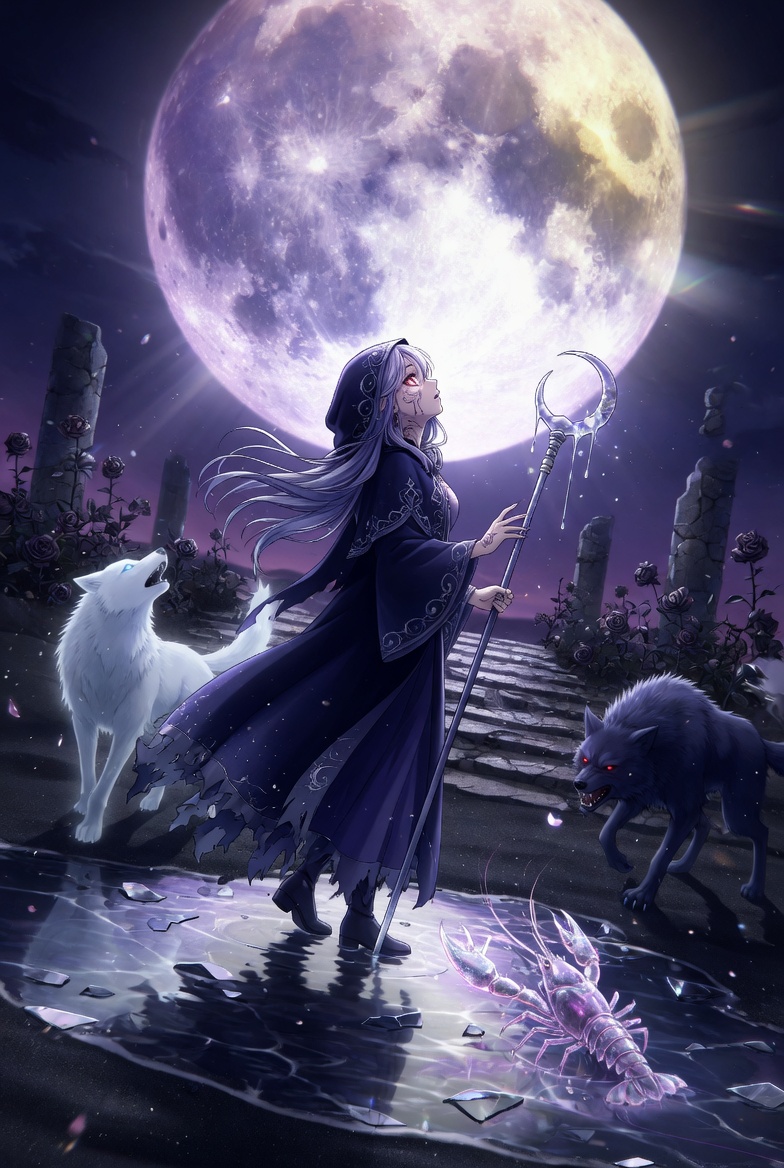
If the Devil is the thing you won’t put down, the Moon is the thing you can’t quite see. It’s the card of the murky and the half-lit: fears without a clear source, dreams that mean more than they seem to, that low background hum of anxiety you can’t trace to anything specific.
The Moon governs the emotions that live below language. Old fears from childhood that still fire in adult situations. The dread you feel before a certain kind of conversation, out of proportion to the conversation itself. The Moon is often where inner child material surfaces, because a lot of what’s buried down there got buried before you had the words to file it properly.
When the Moon shows up, it’s a sign not to force clarity. The useful question isn’t “what does this mean” but “what am I afraid I’d find if I looked?” You follow the feeling down instead of explaining it away. (We’ve since given the Moon a full reading of its own, including why the buried material picks bad light to surface.)
Work it like this: when a reaction feels bigger than the moment that triggered it, treat that as a Moon signal. Ask: how old do I feel right now? Sometimes the honest answer is seven. That’s the inner child raising a hand. You don’t have to fix it in that moment. You just have to notice it’s there and stop talking over it.
The Five of Cups: The Grief You Skipped

The Five of Cups shows a cloaked figure staring down at three spilled cups, so fixed on the loss that they haven’t turned to see the two cups still standing behind them. It’s a card about grief, and specifically about grief that got stuck.
Most of us have a spilled cup we never properly mourned. A version of our life that didn’t happen. A person we lost, or a relationship with someone still alive. A younger self we abandoned to survive. Shadow work often means going back to a cup you stepped over years ago because there wasn’t time or safety to feel it then. The unfelt grief doesn’t age well. It calcifies into numbness, or leaks out sideways as irritability and low mood.
The Five of Cups is not telling you to cheer up and count the two full cups. That’s the toxic-positivity misreading. It’s telling you the two cups will still be there after you let yourself feel the three, and that you’re allowed to turn around only once the grieving has had its turn.
Work it like this: finish the sentence “I never let myself be sad about…” and then don’t argue with what comes out. The thing you’d most like to skip is the cup on the ground.
The Tarot Shadow Journal (A Template You Can Reuse)
Here’s the repeatable part. You don’t need a new ritual each time. You pull one card, and you run it through the same five prompts. Do it by hand if you can; the slowness matters. (If you’d rather keep the entries together on the site, the five prompts are waiting in your journal.)
The Tarot Shadow Journal
- The card. Name it and note your first gut reaction before you look up any meaning. That raw reaction is data.
- What it’s pointing at. Where in my life does this image land? Be specific. A person, a habit, a memory, a fear.
- The part I’d rather not admit. What’s the version of this I wouldn’t say out loud to a friend? This is the actual shadow line. If nothing uncomfortable surfaces, you haven’t reached it yet.
- The payoff or the fear. What am I getting from keeping this as it is, or what am I afraid would happen if I changed it?
- One small, kind next step. Not a life overhaul. One honest thing: a boundary, a conversation, an hour of rest, a sentence said out loud to yourself.
The closing question, every time: which prompt did I most want to skip? That one was the point.
Keep the entries. Over a few weeks you’ll see the same chain, the same spilled cup, the same seven-year-old showing up under different cards. That pattern recognition is where the real change starts, and you can’t get it from a single session. (The Shadow Journal has its own chapter in the complete guide to tarot spreads, with the rest of our practices around it.)
Keep Your Nervous System in the Room
Shadow work that flattens you isn’t working; it’s just re-wounding you. The goal is to stay connected to the hard material without getting swamped by it, and that’s a body thing more than a mind thing. A few rules that keep the practice safe:
- Feet on the floor before you start. Ten slow breaths, longer out than in. You’re telling your body it’s safe enough to open a difficult drawer.
- One card, not ten. A big spread on heavy material is how you overwhelm yourself. Depth comes from staying with one image, not stacking more.
- Notice when you’ve left your body. Going numb, foggy, floaty or suddenly very sleepy is your system hitting its limit. That’s the stop sign, not a failure.
- Close the session on purpose. Put the card away, stand up, drink some water, do something ordinary and physical. You’re signalling that the drawer is shut again.
- Small doses. Fifteen minutes once or twice a week does more than a two-hour excavation that leaves you raw for days.
If a reading leaves you more able to breathe and act, it’s working. If it leaves you spiralling, dissociated or unable to put it down, that’s the practice asking you to slow down, not push harder.
When to Close the Deck and Call a Professional
This matters, so read it slowly. Tarot is a tool for reflection. It is not therapy, and there are places it should not go alone.
Put the cards down and speak to a qualified therapist or your doctor if:
- You’re touching trauma that pulls you under, causes flashbacks, or makes you feel unsafe in your own body.
- Reflection tips into rumination you can’t switch off, or into persistent low mood, hopelessness or anxiety.
- You have any thoughts of harming yourself. This is not a cards moment. Contact a crisis line or emergency services in your country right now.
- You find yourself unable to make any decision without pulling cards first, or re-drawing until the deck says what you wanted. That’s dependence, and it’s a signal to step back.
There is nothing weak about needing more than a deck can give. A card can show you the door. Some rooms should be walked into with a trained professional beside you, not a shuffled stack of card stock. Good shadow work knows its own edges.
The Bottom Line
Shadow work stays vague because looking at your own hidden material is genuinely hard, and most advice skips the only difficult part: getting in the door. Tarot doesn’t skip it. It hands you an image you didn’t choose, aimed at something you were avoiding, and asks you to be honest for five minutes.
Use the Devil to find what owns you. Use the Moon to sit with what you can’t quite see. Use the Five of Cups to grieve the thing you stepped over. Run each one through the same five journal prompts, keep your feet on the floor, and know when the work is bigger than a deck.
The cards can’t do the feeling for you. They’re just very good at showing you where it lives.
FAQ
Do I need to know tarot to do shadow work with it? No. Start by reacting to the image before you read any meaning. Your gut response to the picture is often more useful for shadow work than the textbook definition, because it comes straight from the material you’re trying to reach.
Which cards are best for shadow work? The Devil, the Moon, the Tower, the Five of Cups, the Nine of Swords and the Ten of Swords tend to open the deepest doors, but any card works if you ask “where does this land in me?” The point isn’t the card, it’s the honesty you bring to it.
Is tarot shadow work a replacement for therapy? No, and it shouldn’t try to be. It’s a reflective practice that can sit alongside therapy or stand as gentle self-inquiry, but trauma, persistent low mood, and any thoughts of self-harm need a qualified professional, not a deck.
How often should I do this? Little and often. Fifteen minutes once or twice a week, one card at a time, beats a long heavy session. Shadow work rewards a steady drip, not a flood.
Want a door to start with? Pull a free online tarot reading →, no sign-up needed, and run whatever card you get through the five prompts above.
forum Comments
Loading comments…