
You were told to clear your mind and just follow your breath. You lasted about ninety seconds. Your legs fidgeted. Thoughts piled up. You felt like a failure. Feeling like you failed does not mean meditation is impossible for you. You were handed the hardest version first. Some people bounce off breath-and-silence meditation. Looking at one tarot card is a gentler way in. It gives your eyes a small, fixed thing to rest on.
Why Meditation Goes Wrong for Some People
The usual instructions give a busy brain almost nothing to hold. Empty your mind. Watch the breath. Sit still. For some people that is simply boring. For others, paying close attention to breathing makes the body tense up. Neither group is bad at meditation. The first thing they were given was the version with the least to hold on to.
A restless mind wants somewhere to land. Silence and an invisible breath do not always supply that. The mind notices the lack of a job and starts inventing one, often in the form of worry or fidgeting. That is ordinary. The first method they tried simply left the mind with no clear place to come back to.
Give Your Eyes a Job
A card helps because it is full of small, ordinary details. Colours. Faces. Hands. Background shapes. Those details pull attention without much effort. The card is a small, fixed object with clear edges, so there is an obvious place to return when the mind drifts. You can hold the physical card, which gives fidgety hands something to do. And it ends: there are only so many things in one picture.

The Princess of Swords shows the kind of looking this practice asks for. Our art has a young woman with short silver and blue hair, a sword held out in one hand, a falcon on her shoulder, holding two fingers up beside her eye with a grin, standing in windswept ruins. Her tagline is “She will find the truth. Be certain of it.” That is the curious, detail-hunting attention: notice one small thing, then the next.
It’s Still Meditation (Sort Of)
Looking at one thing, noticing when the mind drifts, and coming back is what a lot of meditation actually is. The card just makes the process friendlier. The drifting is part of the exercise. Every time you notice you have wandered and return to the card, that return counts. It is like one lift at the gym. The meditation guide on this site makes the same point.
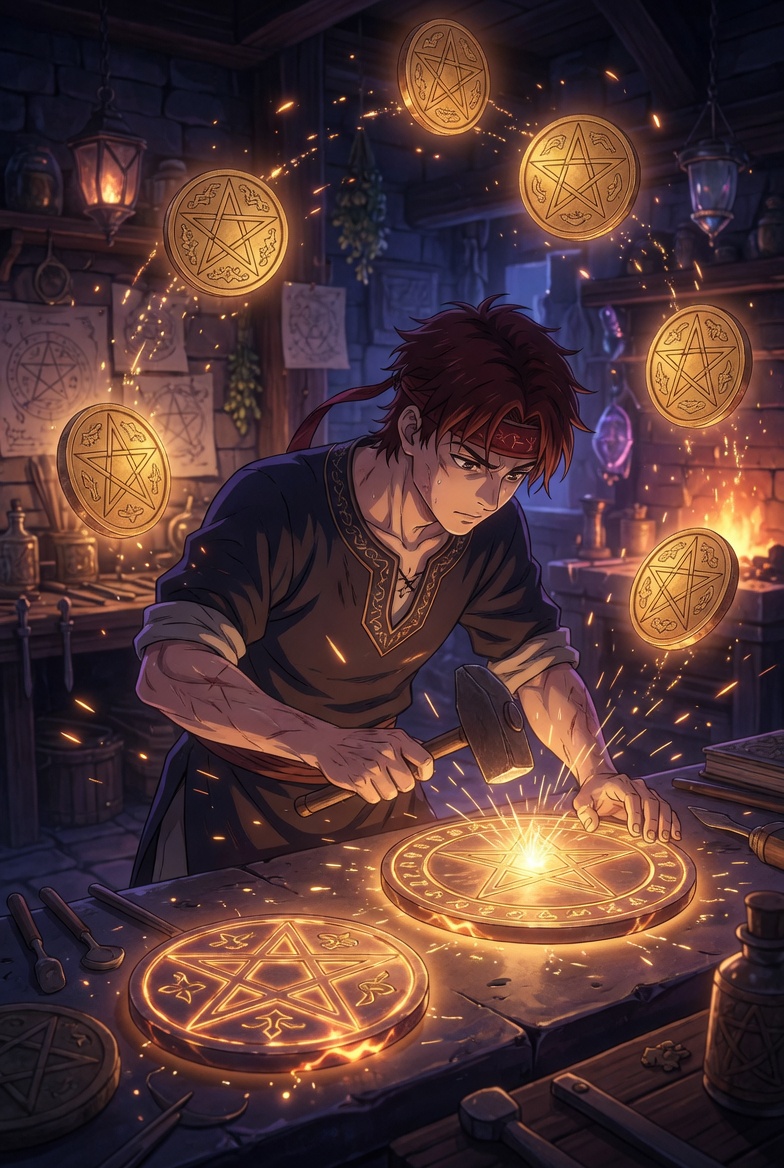
The Eight of Pentacles fits the idea of repetitions. Our art shows a young craftsman in a red headband striking a glowing coin on his workbench with a hammer, sparks flying, finished coins floating around him. His tagline is “Master one thing. Then master it again.” Each time you come back to the card is one more repetition.
Resting the eyes on a candle flame or a picture is an old way of focusing in several traditions. Nothing mystical is happening here. The card does not send anything. What changes is where your attention goes. That shift is worth having for its own sake.
The Ten Things
Pull a card, or pick one you already like. Find ten small details in it, one at a time, and count them, out loud or on paper. Be specific: “a crack in the third step”, never “some steps”. If your mind wanders and you lose count, that is fine. Notice, go back to the last number you remember, and carry on. Stop at ten. Then write one line in the journal. The whole thing takes about three minutes.
The journal line: Today’s card: ___. The detail I’d never noticed: ___. Where my mind went when I lost count: ___. Write it in your journal ›
If you are very restless, say the details out loud. Or sketch the card badly. Or trace the edges with a finger while you look. For people who like it and want more, the meditation guide has five more methods.
The Restless Part of You

The Prince of Wands is the part of you that cannot sit still. Our art has a grinning red-haired rider in black and gold armour on a black horse with a mane of flames, holding up a burning staff topped with a fiery bird, riding across a desert with pyramids behind him and streaks of fire in the air. His tagline is “Fast, brilliant, and slightly dangerous.” That restless part can stay. It just needs a job.
Strength is the picture of how to treat a wandering mind. Our art shows a young woman with long silver hair, in a white dress, resting her hand gently under the jaw of a huge lion. Their faces are close and the lion looks calm. A large silver infinity symbol hangs in the bright sky above her, with a small four-pointed star above that, and pale flowers grow behind them. Her tagline is “Gentleness is the greatest power.” A gentle hand bringing the big restless animal back, never a fight.
When to Skip It
In a flooded or panicky moment, settle the body first. The grounding reference covers simple ways to do that. Looking at a card is not a treatment for anxiety, depression or trauma. If your mind feels unsafe or anxiety is getting in the way of ordinary life, talk to your doctor. If any practice, this one included, brings up something painful, stop. That is allowed. The anxious-minds guide has more on this.
The Bottom Line
Looking at one tarot card gives a restless mind a clear, finite job. That job is a friendlier version of the same attention practice most meditation uses.
A card is something good to look at. That is enough.
FAQ
What can I do if I can’t meditate? Try looking at one tarot card and naming ten small details in it. That gives your eyes and hands a concrete job. It takes about three minutes. Some people who bounce off breath-and-silence meditation find this easier.
Is tarot a form of meditation? Looking at one card, noticing when your mind drifts, and coming back is a form of attention practice. The card itself does nothing special. It is simply a detailed picture that makes the practice clearer for some people.
How do you meditate with a tarot card? Pull or pick a card. Find ten specific details and count them. If you lose count, go back to the last number and continue. Stop at ten and write the journal line. That is the whole practice.
Do I need to believe in tarot for this to work? No. You are looking at a picture. The secular guide explains the same approach without any belief required. The card is just something with edges and details.
What if my mind keeps wandering? Wandering is expected. Each time you notice and return to the card, that return is the exercise. Go back to the last number you remember and keep counting to ten.
Which tarot card is best to start with? Any card with lots of detail works. Or pull one at random. The practice is the same either way.
Ready to find the first of your ten things? Pull a free online tarot reading →
forum Comments
Loading comments…