Grounding With the Deck: A Small Reference
Ten small practices for coming back to your body and the room, each one hung on a card that teaches it. Sixty seconds each, no belief required, and no deck needed in your pocket.
What Grounding Is
Grounding is the small skill of coming back: out of the spiral, out of the imagined argument, out of the feed, and back into your body and the room you are actually in. It takes about a minute. It asks for no beliefs. And it works for a plain reason: your attention can only be in one place at a time, so a minute spent on your feet, your breath or the objects around you is a minute the spiral goes unfed.
The trouble with grounding was never that it fails. It's that nobody remembers to do it. In the flooded moment, the last thing your mind serves up is the calm little exercise you read about last month. That's the gap this page fills, and it's why each practice here hangs on one tarot card. A card is a picture, and pictures are what memory is good at. Learn the Full Stop from the Four of Swords once, and the card will hand it back to you every time you see it, think of it, or draw it.
You don't need the deck on you. The card is the reminder, and it travels in your head. But if the deck is within reach, there's a lovely version of this page: draw one card from these ten, and do whatever practice it teaches. The shuffle picks your minute for you.

Five for the Body
Start here when the flooding is physical: racing heart, tight chest, jaw doing overtime. The body settles the mind far more reliably than the mind settles the body, and every practice in this half works through muscle and breath. Sixty seconds each. Do one, or stack two.
The Full Stop (Four of Swords)#
Stop. Let your hands finish what they were doing and rest. Sit, drop your shoulders, and let your eyes settle on one point for a full minute of deliberate nothing. The card shows a knight who has hung the fight up for now: the swords wait, and so can everything else. Its tagline gives you permission: stillness is not weakness, it is strategy. For one minute, take that literally.
The Slow Pour (Temperance)#
Three breaths where the exhale is a pour. Breathe in normally, then let the air out in a thin, slow, steady stream, the way Temperance pours between cups without spilling a drop. The pour cannot be rushed; that is the whole art of the card. When the out-breath wants to dump all at once, thin the stream. By the third pour, most bodies have taken the hint.
The Long Exhale (Strength)#
Make the out-breath longer than the in-breath, and do it five times. In for a count of four, out for a count of six or more. A long exhale slows the heart a touch; it is the body’s own settle signal, and you can send it on purpose. The card is the picture: a lion calmed by a gentle hand, no force anywhere. The lion is your nervous system. The hand is your breath.
Sit Like a Throne (The Emperor)#
Both feet flat on the floor. Back given fully to the chair. Hands resting, not gripping. Now let the chair and the floor do all the holding, and notice how much weight you were carrying in your own muscles for no reason. The Emperor rules from a seat, and so, for the next minute, do you. Weigh more. The ground can take it.
Put One Thing Down (Ten of Wands)#
Physically. The phone, the mug, the bag on your shoulder: set one real thing down, and let your shoulders come down from your ears as it lands. Unclench the jaw while you’re there. The card’s figure carries all ten staves at once, and its tagline is the instruction: you have carried this long enough. Your body believes what your hands do.
Why breath and muscle work when arguing with a spiral does not: the mechanics in full, honestly told:
Tarot is a nervous system toolarrow_forward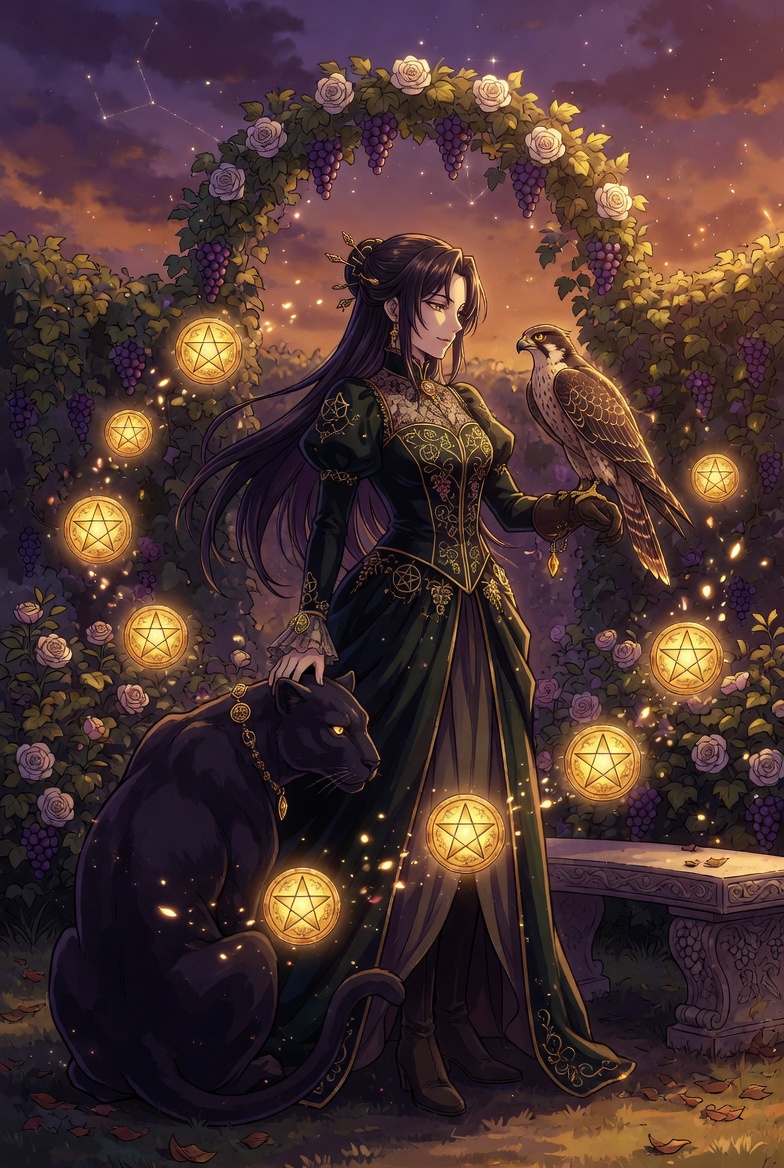
Five for the Room
The second five work through attention rather than muscle. Anxiety runs on imagined places: the meeting that hasn't happened, the conversation being rehearsed, the future being previewed. These practices bring your attention back to the one place that is verifiably real, which is the room you are standing in.
Five Things (The Empress)#
Name five real things you can see, slowly, as if pointing them out to a visitor. Then four you can hear, three you can touch. This is the classic senses count, and the Empress is its patron: her card is the world insisting on being noticed, life growing in every direction. The spiral is a story with no scenery. Give your attention scenery and the story thins.
The Blindfold Check (Eight of Swords)#
The card’s figure stands caged by swords, and the cage is made of her own certainties. The check: say what the story in your head claims is happening, then look around and say what is actually happening, here, now. “The story says everything is collapsing. The room says I am holding a cup of tea.” The room is not lying to you. The gap between the two sentences is the blindfold, and naming it loosens the knot.
Water, Both Ways (The Star)#
Real water, used slowly. Run the cold tap over your wrists for thirty seconds, or drink a glass at half your usual speed. While the water moves, let one worry go down with it, said once, out loud if you can. The Star pours water out and takes nothing back, and does it under open sky at night: the deck’s calmest picture, and the closest tarot comes to a tap.
The Walled Garden (Nine of Pentacles)#
Name three things in your life that are yours and finished. Built, learned, paid off, mended, done. Not pending, not in progress: finished. Anxiety lives entirely in the pending, so a minute spent standing in the finished is a minute it cannot follow you into. The card’s tagline says it exactly: she built this, it is entirely hers. So did you. Walk the walls.
The Carry Card (The Hermit)#
A morning practice with an all-day payoff. Draw or choose one card, look at it properly for a moment, and put it in a pocket. Each time your hand finds it during the day: one breath, one question, “where am I, actually?” The Hermit’s light is carried, not installed, and that is the whole trick. You are allowed a portable reminder that you exist in a body, in a place, in this hour.

When Grounding Is Not Enough
Honesty section, as ever. Grounding manages a moment. It does not treat a cause, and it was never meant to. If the flooding is frequent, if panic arrives with a racing heart at random hours, or if you are running these practices many times a day just to function, that is not a failure of technique. It is information, and it deserves more support than cardboard: your GP is the front door, and in England you can refer yourself directly to NHS talking therapies without seeing anyone first. If things are heavy right now, Samaritans are on 116 123, free, any hour.
One more honest line: these practices are borrowed. The senses count, the long exhale, the cold water: all of it comes from ordinary psychology and predates any deck. What the cards add is memory, a picture per practice, so the tool is findable in the moment you need it. That is a real contribution, and it is the only one we claim.
The full manual for anxious readers, including what tarot honestly can and cannot do for anxiety, lives here:
Tarot for anxious minds: a complete guidearrow_forwardReady to sit down with a card for longer than a minute? The full meditation manual, five methods, taught honestly:
The complete guide to tarot meditationarrow_forwardThe deck-in-hand version of this page: draw one card and do the practice it teaches. One free card, no sign-up:
Draw your minutearrow_forwardTen practices, one design: attention can only be in one place at a time, so give it your feet, your breath, or the room. The cards just remember the practices for you, one picture each. The ground was there the whole time. Grounding is noticing you are standing on it.