The Lesser Banishing Ritual of the Pentagram: A Complete Step-by-Step Guide
The full ritual, taught properly: where it comes from, what every word and gesture means, how to say the names, and a four-week path to learning it by heart.
Where This Ritual Comes From
The Lesser Banishing Ritual of the Pentagram, usually shortened to LBRP, comes from the Hermetic Order of the Golden Dawn, a society founded in London in 1888 to study ritual, symbolism and the Western mystery traditions. It was the first ritual the order taught to new members, and the one they were told to practise daily. Everything else in the system was built on top of it, the way scales sit underneath music.
For decades the ritual was secret. That ended in the late 1930s, when a former member named Israel Regardie decided the material deserved to outlive the order and published its teachings in full. Nearly every version of the LBRP taught today, including this one, descends from what Regardie set down.
If you are here from the tarot side, this family tree matters more than you might expect. The Golden Dawn did not just produce a banishing ritual. Its members and their students produced the card meanings, the elemental system, and the deck structure that almost every modern tarot reader uses, including the most famous deck in the world, created by two of its members. When a tarot reader performs the LBRP before a reading, they are not mixing two traditions. They are using two rooms of the same house.
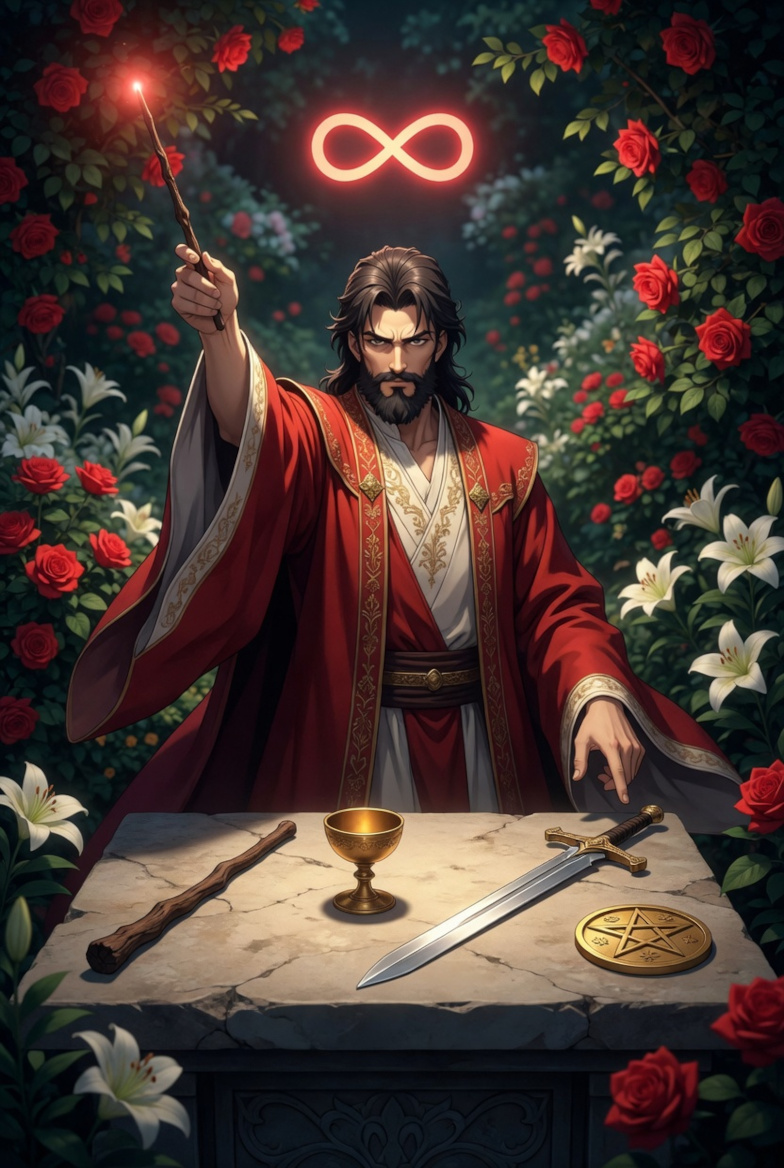
What the Ritual Is For
Ask a traditional practitioner and they will tell you the LBRP clears a space of unwanted influence, settles the self, and marks out a protected circle before serious work: meditation, magic, or divination. The word banishing is doing exactly what it says. You are sending away everything that should not be in the room while you work.
Ask a psychologist and they will describe the same ten minutes differently: a fixed sequence of movement, breath, spoken sound and vivid visualisation that reliably shifts a person out of everyday scattered attention and into a calm, focused state. Research on ritual keeps finding the same thing: a set routine before a demanding task steadies people and sharpens focus, and it works whether or not they believe anything special is happening.
You do not have to choose between those two descriptions. They may simply be two languages for one event. We wrote a companion piece on the plain-language view, and it matters here for one reason: whichever way you understand the ritual, the instructions below are identical, and so is the state you finish in.
Before You Start
You need almost nothing. Ten minutes. Enough floor to stand and turn in a circle. No tools, no robes, no altar. Tradition says face east to begin; if you do not know which way east is, pick the direction that feels like the front of the room and be consistent.
One term needs explaining before the steps make sense. The old instructions say to vibrate the sacred words. This does not mean anything strange. It means saying a word slowly and steadily on one long out-breath, stretched out, a little louder and deeper than normal speech, so you can feel the sound resonate in your chest. Ah-teh becomes Aaah-tehhh. If you have ever hummed a long low note and felt it in your ribs, you already know the feeling. In a shared house, a firm whisper works. Silent, in the mind with full attention, also works. Loud enough to feel is best.
Do not try to memorise everything before your first attempt. Read each part, walk it through slowly with this page open, and let repetition do the memorising. The four-week plan at the end of this guide breaks it into pieces.
Part One: The Qabalistic Cross
The ritual opens by tracing a cross of light on your own body while speaking five words. The words are Hebrew, and together they say: Thine is the kingdom, the power and the glory, forever. If that sounds familiar, it should. It is a close cousin of the closing line of the Lord's Prayer.
Stand straight, feet together, arms at your sides. Take a slow breath and let it out. Imagine, above your head, a sphere of brilliant white light.
Touch your forehead with your right hand. Vibrate: ATEH (Ah-teh). It means Thine. As you speak, imagine drawing a beam of that light down to your forehead.
Touch the centre of your chest. Vibrate: MALKUTH (Mahl-koot). It means the Kingdom. Imagine the beam of light continuing down through your body to your feet.
Touch your right shoulder. Vibrate: VE-GEBURAH (v'ge-boo-RAH). It means and the Power. Imagine light gathering at your right shoulder.
Touch your left shoulder. Vibrate: VE-GEDULAH (v'ge-doo-LAH). It means and the Glory. Imagine the light sweeping across your chest to the left shoulder, completing the horizontal beam of a cross.
Bring your palms together at your heart. Vibrate: LE-OLAM, AMEN (leh-oh-LAHM, Ah-men). It means forever, amen. Rest for a breath inside the cross of light you have just drawn.
That is the whole opening. Done on its own, slowly, it is a complete two-minute centering practice, and many people use it exactly that way.
Part Two: The Four Quarters
Now you will walk a circle, drawing a five-pointed star in the air at each of the four compass points and speaking a divine name at each one.
The star is drawn in one continuous line, and the direction matters in tradition: this is the banishing form. Start at your lower left, roughly at your left hip. Draw the line up to a point above your head. Down to your lower right hip. Up to your upper left, about shoulder height. Straight across to your upper right. Then down and back to the lower left where you began. Five lines, one star. Imagine it hanging in the air in blue flame, about as tall as your body. Take your time; smooth beats fast.
Facing EAST, draw the pentagram. Stab your fingers gently toward its centre and vibrate: YHVH (Yod-Heh-Vav-Heh, often voiced Yah-weh). Turn clockwise a quarter turn.
Facing SOUTH, draw the pentagram. Vibrate: ADONAI (Ah-doh-nye). It means Lord. Turn clockwise.
Facing WEST, draw the pentagram. Vibrate: EHEIEH (Eh-heh-yeh). It means I Am. Turn clockwise.
Facing NORTH, draw the pentagram. Vibrate: AGLA (Ah-gah-lah). It is an abbreviation of a Hebrew sentence meaning Thou art mighty forever, O Lord. Complete the circle by turning clockwise back to the east.
As you move between quarters, imagine your outstretched hand trailing a line of white light, so that by the time you return to the east the four flaming stars are joined by a complete circle of light with you at its centre.

Part Three: Calling the Archangels
Stand in the centre of your circle, facing east, and stretch your arms out to the sides so your body forms a cross. You will now name four archangels, one at each quarter, and picture each one as you speak. The images below are the traditional ones; let them be as vivid or as simple as your imagination allows.
Say: Before me, RAPHAEL (Rah-fah-el). Picture a towering figure in yellow and violet robes ahead of you in the east, with a sense of moving air, wind and breath.
Say: Behind me, GABRIEL (Gah-bree-el). Picture a figure in blue robes behind you in the west, holding a cup, with the feeling of falling water.
Say: On my right hand, MICHAEL (Mee-kah-el). Picture a figure in red robes to your right in the south, holding a sword, with the heat and light of flame.
Say: On my left hand, URIEL (Oor-ee-el). Picture a figure in earthy greens and browns to your left in the north, holding a shield or a disc, with the stillness of stone and field.
Then say the ritual's most famous lines: For about me flame the pentagrams, and within me shines the six-rayed star. As you do, picture all four stars burning at their quarters, the circle joining them, and a golden six-pointed star glowing at your own heart.
Part Four: Closing
Finish by repeating the Qabalistic Cross exactly as you opened: forehead, chest, right shoulder, left shoulder, hands at the heart, the same five words. The ritual ends where it began, and the repetition is the point. It brackets everything between the two crosses as set-apart time.
Then stand still for a moment before you move on. Notice the state you are in. Most people report the same cluster of things: quieter head, slower breath, a strong sense of being exactly where they are. That state is the product. Whatever else you believe just happened, that much is reliably real, and it is the ideal state in which to shuffle a deck, meditate, or simply return to your evening a little clearer than you left it.
Week one: the Cross only
Do just the Qabalistic Cross, morning or evening, every day for a week. Five words, five touches, two minutes. Learn it until your hands move without thinking. This piece alone is a complete practice.
Week two: add the stars
Cross, then the four quarters with their pentagrams and names, then stop. Walk the circle slowly with the instructions open until the order of names (YHVH, ADONAI, EHEIEH, AGLA) sits in memory. Do not worry about vivid visualisation yet.
Week three: add the archangels
Run everything and add the four archangels with their pictures. This is the week the ritual starts to feel inhabited rather than recited. Keep the images simple: a colour, an element, a presence at each quarter is enough.
Week four: the full ritual, daily
Both crosses, the quarters, the archangels, unhurried: about ten minutes. Try it once before a tarot reading this week and notice what the reading is like on the other side of it. After a month you will know whether this practice is for you.
The banishing works. What it reliably banishes is everything your attention was carrying when you walked in.

Variations and Honest Notes
Seated and silent versions are fine. Tradition prefers standing and speaking, and the movement and sound genuinely help, but a version you can actually do beats a perfect version you skip. In a flat with thin walls, whisper. In an office, run it through in your mind with your eyes closed. The structure carries most of the weight.
If the religious vocabulary is not yours, you have two honest options. One is to treat the Hebrew names as inherited sound, the way a singer performs a requiem without signing up to its theology; many practitioners hold it exactly that way. The other is to use a secular adaptation that keeps the structure and drops the names. Our companion blog post includes a simple one, the four quarters minus the angels, which takes two minutes and no vocabulary at all.
And to say it plainly, as we do everywhere on this site: none of this is required for tarot. The ritual is a door into a focused state, not a toll booth in front of the cards. Plenty of superb readers have never drawn a pentagram in their lives. If the LBRP calls to you, learn it properly and enjoy it; it is a remarkable piece of design. If it does not, bring one honest question to the deck instead. That was always the load-bearing part.
Want the shorter version first, including what deck cleansing customs are really doing and the psychology behind all of it?
Read the companion blog postarrow_forwardPrefer to be walked through it? Our free guided version paces every stage of this ritual to your breath, on screen.
Run the guided ritualarrow_forwardTen minutes of breath, movement and old words, and you arrive somewhere quieter than you started. However you explain it, that is a door worth knowing how to open. Learn it slowly, use it freely, and let it serve the reading, never the other way round.